
Clinical Images and Case Reports Journal | PubMed
  • contact@literaturepublishers.org
  • Whitley Bay, NE26 2HU, England, UK
  • Submit Manuscript
Article Details

Clinical Image

Volume 4, Issue 7 (July Issue)

Endoscopic View of Epiglottitis - An Uncommon Presentation in Adults

Richard Koonoolal*, Josh Jurawan, Rodolfo Arozarena Fundora and Solaiman Juman

Department of Clinical Surgical Sciences, University of West Indies, Eric Williams Medical Sciences Complex, Champs Fleur, Trinidad and Tobago

*Corresponding author: Richard Koonoolal, Department of Clinical Surgical Sciences, University of West Indies, Eric Williams Medical Sciences Complex, Champs Fleur, Trinidad and Tobago. E-mail: koonoolal@gmail.com

Received: June 29, 2022; Accepted: July 07, 2022; Published: July 20, 2022

Citation: Koonoolal R, Jurawan J, Fundora RA, Juman S. Endoscopic View of Epiglottitis (An Uncommon Presentation in Adults). Clin Image Case Rep J. 2022; 4(7): 248.
Endoscopic View of Epiglottitis - An Uncommon Presentation in Adults
Abstract

A 57-year-old male, non-smoker presented to the Emergency Department with dysphagia, dyspnea and hoarseness of voice for one-day duration. He was previously well with no known co-morbidities and no history of recent surgeries or laryngeal trauma. His vitals were unremarkable at the time of presentation except for a mild sinus tachycardia of 103 bpm. Examination of the oral cavity and posterior oropharynx was unremarkable. A flexible laryngoscopy was performed which showed significant erythema and oedema of the epiglottis. Despite this oedema of the epiglottis, the glottis could be seen around the swelling, there was no sign of oedema or obstruction at the level of the glottis. The patient was diagnosed as acute epiglottitis and was managed by the ENT department under continuous nursing supervision and coordinated care with the intensive care unit. He received dexamethasone, adrenaline nebulisation and amoxicillin. The patient did not require intubation and showed complete clinical resolution in one week.

Acute epiglottitis is a life-threatening disorder which can occur at any age. The management, occurrences and trends of epiglottitis generally vary between adults and children. Epiglottitis can present itself through the occurrence of high fever, severe sore throat, difficulty in swallowing, shortness of breath, dysphagia and drooling. The most common presenting symptom in adults is odynophagia (100%), dysphagia (85%) and voice change (75%) [1].

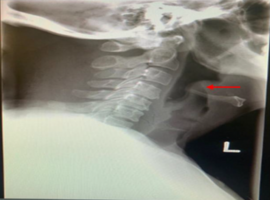
Epiglottitis can be commonly misdiagnosed as croup or foreign body in the airway. Radiographs of the neck are very effective in diagnosing epiglottitis. The radiological “thumb sign” (Figure 3) identifies acute epiglottitis which shows severe inflammation of the epiglottis with the potential for permanent loss of the airway [2].

Epiglottitis can be a life-threatening condition if swelling progresses to the point of closing off air passages to the lungs. As such this condition should be treated as soon as a diagnosis is made.