
Clinical Images and Case Reports Journal | PubMed
  • contact@literaturepublishers.org
  • Whitley Bay, NE26 2HU, England, UK
  • Submit Manuscript
Article Details

Clinical Image

Volume 4, Issue 8 (August Issue)

Fibro-adipose Vascular Anomaly

Jennifer Laborada1,2 and Deborah E. Schiff1,3*

1Rady Children’s Hospital, San Diego, CA

2UC Riverside School of Medicine, Riverside, CA

3UC San Diego School of Medicine, La Jolla, CA

*Corresponding author: Deborah E. Schiff, Rady Children’s Hospital, San Diego, CA; UC San Diego School of Medicine, La Jolla, CA. E-mail: dschiff@rchsd.org

Received: July 30, 2022; Accepted: August 08, 2022; Published: August 21, 2022

Citation: Laborada J, Schiff DE. Fibro-adipose Vascular Anomaly. Clin Image Case Rep J. 2022; 4(8): 256.
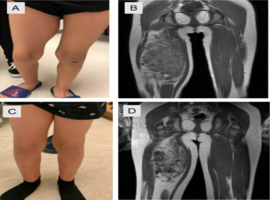
Fibro-adipose Vascular Anomaly
Abstract

A 9-year-old boy presented with a 10-month history of a swollen, painful right thigh and inability to weight-bear (A). MRI/MRA demonstrated a large low-flow heterogeneous fat-containing soft tissue mass that infiltrated the adductor muscle (B). A non-diagnostic needle biopsy revealed myositis with small vessel lymphocytic vasculitis, vascular changes, and edema. A diagnosis of fibro-adipose vascular anomaly (FAVA) was rendered by the multidisciplinary Vascular Anomalies Team. He was treated with oral mTOR inhibitor sirolimus, and within 3 months, he could fully weight-bear with decreased pain and swelling (C). Repeat MRI after 1 year of sirolimus showed decreased size and enhancement of the right thigh mass (D).

FAVA is a rare vascular anomaly characterized by fatty infiltration of affected muscles. Most cases are caused by somatic PIK3CA mutations. Severe pain and muscle contractures are common features. Treatment includes systemic therapy with inhibitors of the PI3K/AKT/mTOR pathway, cryoablation, surgical resection, and physical therapy.