
Clinical Images and Case Reports Journal | PubMed
  • contact@literaturepublishers.org
  • Whitley Bay, NE26 2HU, England, UK
  • Submit Manuscript
Article Details

Case Report

Volume 8, Issue 2

Identification of a PKD1 Non-truncating Variant Presenting with a Rapid Progression: A Case Report

Natalie Ciantar1, Julian Delicata1,2, Emanuel Farrugia2, Graziella Zahra3 and Edith Said1,4*

1Faculty of Medicine and Surgery, Centre for Molecular Medicine and Biobanking, University of Malta, Malta
2Department of Medicine, Nephrology and General Medicine Division, Mater Dei Hospital, Malta
3Department of Pathology, Molecular Diagnostics Laboratory, Mater dei Hospital, Malta
4Department of Pathology, Section of Medical Genetics, Mater Dei Hospital, Malta

*Corresponding author: Prof. Edith Said, Faculty of Medicine and Surgery, Centre for Molecular Medicine and Biobanking, University of Malta, Malta; Department of Pathology, Section of Medical Genetics, Mater Dei Hospital, Malta. E-mail: edith.said@um.edu.mt

Received: April 08, 2026; Accepted: April 22, 2026; Published: May 05, 2026

Citation: Ciantar N, Delicata J, Said E, et al. Identification of a PKD1 Non-truncating Variant Presenting with a Rapid Progression: A Case Report. Clin Image Case Rep J. 2026; 8(2): 586.
Identification of a PKD1 Non-truncating Variant Presenting with a Rapid Progression: A Case Report
Abstract

Background: Genetic diagnosis in cases with autosomal dominant polycystic kidney disease (ADPKD)is important in determining prognosis and enabling risk recurrence in the family. PKD1 is the commonest gene in ADPKD and genotype phenotype correlation with the type of variant has been reported. Studies on the molecular genetic diagnosis of ADPKD have identified several variants classified as variants of uncertain significance presenting a challenge in interpreting their significance in disease progression.
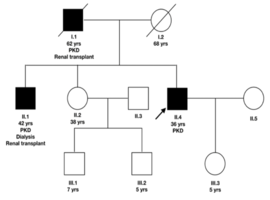
Methods: The proband presented with a family history of ADPKD and severe progression of his condition. Molecular genetic diagnosis of the proband using a gene panel NGS identified a non-truncating missense variant of uncertain significance in the PKD1 gene (c.9397G>T). Segregation studies in the family confirmed that the variant segregated with the disease and studies using quantitative PCR confirmed its effect on gene.
Results: The segregation and RNA expression studies enabled the re-classification of the variant from variant of uncertain significance to likely pathogenic which correlated well with his clinical presentation. This case highlights the importance of accurate classification of genetic variants in patients with ADPKD to enable correct prognosis and management and indicates the possibility of additional factors that may influence genotype phenotype correlation.