
Clinical Images and Case Reports Journal | PubMed
  • contact@literaturepublishers.org
  • Whitley Bay, NE26 2HU, England, UK
  • Submit Manuscript
Article Details

Case Report

Volume 3, Issue 12 (December Issue)

Intraductal Papillary Mucinous Neoplasm Disguised as Pyrosis and Hyperglycemia: A Case Report

Jordan Wordekemper1* and Kenneth Sigman2

1School of Medicine, Edward Via College of Osteopathic Medicine – Auburn Campus, Auburn, AL, USA

2Department of Gastroenterology, Grandview Medical Center, Birmingham, AL, USA

*Corresponding author: Jordan Wordekemper, School of Medicine, Edward Via College of Osteopathic Medicine – Auburn Campus, Auburn, AL, USA. E-mail: jwordekemper@auburn.vcom.edu

Received: January 06, 2022; Accepted: January 17, 2022; Published: February 02, 2022

Citation: Wordekemper J, Sigman K, et al. Intraductal Papillary Mucinous Neoplasm Disguised as Pyrosis and Hyperglycemia: A Case Report. Clin Image Case Rep J. 2022; 3(12): 208.
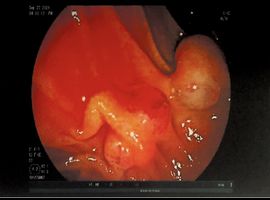
Intraductal Papillary Mucinous Neoplasm Disguised as Pyrosis and Hyperglycemia: A Case Report
Abstract

Abstract Intraductal papillary mucinous neoplasms (IPMN) are increasing in incidence due to more frequent imaging. While most tumors are asymptomatic, some may present with vague gastrointestinal symptoms and laboratory findings. Our patient presented to the emergency room with a history of abdominal pain, vomiting, diarrhea, and a “burning” upper epigastric pain. Evaluation was significant for elevated AST, ALT, and glucose with a CA19-9 of 62.2. Imaging and pathology were suggestive of pancreatic malignancy. As with our patient, clinical suspicion should remain high when older individuals present with new onset diabetes and GI unrest which should warrant further evaluation.

Keywords: Pancreatic adenocarcinoma; IPMN; Pancreas; Hyperglycemia; Pancreatic divisum