
Clinical Images and Case Reports Journal | PubMed
  • contact@literaturepublishers.org
  • Whitley Bay, NE26 2HU, England, UK
  • Submit Manuscript
Article Details

Clinical Image

Volume 3, Issue 8 (August Issue)

Rinophyma in ASMD Niemann-Pick Disease Type B

C. Dionisi-Vici1, Federica Deodato1, Elena Verecchia2, Ludovico Luca Sicignano2, Laura Gerardino2 and R. Manna2*

1Division of Metabolic Diseases, Bambino Gesu Childrens Hospital IRCCS, Rome, Italy
2Fondazione Policlinico Gemelli IRCCS, Periodic Fevers and Rare Diseases Research Center, Catholic University, Rome, Italy

*Corresponding author: Raffaele Manna, Fondazione Policlinico Gemelli IRCCS, Periodic Fevers and Rare Diseases Research Center, Catholic University, Rome, Italy. E-mail: raffaele.manna@unicatt.it

Received: October 05, 2021; Accepted: October 12, 2021; Published: November 03, 2021

Citation: C. Dionisi-Vici, Deodato F, R. Manna, et al. Rinophyma in ASMD (Niemann-Pick Disease Type B). Clin Image Case Rep J. 2021; 3(8): 185.
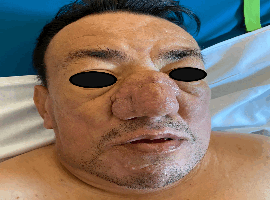
Rinophyma in ASMD Niemann-Pick Disease Type B
Abstract

Recognizing the facies in specific diseases has always been considered a valuable aid in medicine for the diagnosis. Here we show a peculiar skin involvement, as rinophyma in a man of 44-year old, affected by Niemann-Pick disease type B. Diagnosis was established when he was 1-years-old in the Bambino Gesu Childrens Hospital, because oh hepatosplenomegaly. The skin appeared thickened and oily in infancy; the face and nose gradually changed until they reached their present appearance.

Niemann-Pick disease type B (NP-B), known as the 'visceral' form of acid sphingomyelinase (ASMD) deficiency, is caused by homozygous or compound heterozygous mutations in the sphingomyelin phosphodiesterase-1 gene (SMPD1; 607608), which encodes acid sphingomyelinase (ASM) on chromosome 11p15. Differently from the progressive and fatal infantile neurovisceral form (NP-A), NP-B patients may survive into adulthood without central nervous system signs. Serum triglycerides and LDL- cholesterol are often elevated, while HDL-cholesterol is low. The primary organ systems affected in all ASMD patients are the spleen, the liver and the lung, with accumulation of sphingomyelin and other lipids in the cells of the reticuloendothelial system. Indeed, lipid filled foam cells that can be readily detected also in the skin.