
Clinical Images and Case Reports Journal | PubMed
  • contact@literaturepublishers.org
  • Whitley Bay, NE26 2HU, England, UK
  • Submit Manuscript
Article Details

Clinical Image

Volume 3, Issue 3 (March Issue)

Saliva Droplets Emissions are Lower in Children Than in Adults During Babbling Speech and Coughing

Lionel Bouvet1, Joël Lachambre2, Nicolas Tardif2 and Dominique Chassard1*

1Department of Anesthesia and Intensive Care, Hôpital Femme Mère Enfant, Hospices Civils de Lyon, France
2University of Lyon, INSA-Lyon, CNRS UMR5259, LaMCoS, F-69621, Lyon, France

*Corresponding author: Pr. Dominique Chassard, Department of Anaesthesia and Intensive Care, Hôpital Femme Mère Enfant, Hospices Civils de Lyon, France, Tel: (33)427857959; E-mail: dominique.chassard@chu-lyon.fr

Received: February 18, 2021; Accepted: February 25, 2021; Published: March 26, 2021

Citation: Lionel Bouvet, Joël Lachambre, Nicolas Tardif, et al. Saliva Droplets Emissions are Lower in Children Than in Adults During Babbling, Speech and Coughing. Clin Image Case Rep J. 2021; 3(3): 151.

The following videos are related to this article (Video 1, 2 and 3).
Saliva Droplets Emissions are Lower in Children Than in Adults During Babbling Speech and Coughing
Abstract

Transmission of respiratory viruses such as the new coronavirus SARS-CoV-2 occurs mainly through droplets sprayed during sneezing, coughing, or even during speech and normal breathing.
Non-pharmaceutical interventions such as hand hygiene, facemasks, and physical distancing prevent transmission of respiratory viruses. The U.S. Centres for Disease Control and Prevention advocate keeping a physical distancing of six feet to minimize the risk of inter-humane SARS-Cov-2 transmission. This recommendation is based on experimental data only obtained in adults while the spread of virus by children is probably lower than in adults and the ideal physical distancing to minimize SARS-Cov-2 transmission among children remains uncertain. This question is of particular interest in the context of school reopening and because there is no published documents (pictures or video) concerning saliva droplets projections in children.
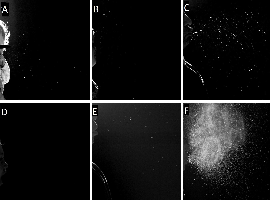
High-speed digital video imaging1 (Phantom® V710, 1000 frames/sec) with light scattering shows that babbling is associated with visible projections of droplets in 12-month-old child (Figure A and Video 1), 5-year-old (Figure B and Video 2) and in adult (Figure C and Video 3), with calculated density of droplets 5 times higher in the adult than in children. Furthermore, 80% of the droplets were sprayed within 40 cm, in children as in adult. Coughing is associated with 20 times less droplets emission in 5-year-old (Figure D) and adult (Figure E) than babbling. Babbling and coughing produce significantly less droplets than sneezing (Figure F).
Thus, young children produce fewer droplets than adults, with potentially similar projection distance. This may result in lower transmission of SARS-CoV-2 by children compared to adults when applying similar physical distancing.