
Clinical Images and Case Reports Journal | PubMed
  • contact@literaturepublishers.org
  • Whitley Bay, NE26 2HU, England, UK
  • Submit Manuscript
Article Details

Case Report

Volume 7, Issue 5

Takotsubo Cardiomyopathy: A Clinical Case of Stress-Induced Cardiomyopathy Without Precipitating Factors

Anne Eliese Daley1*, Gagandeep Grewal2 and Brandi Smith2

1William Carey University College of Osteopathic Medicine, Hattiesburg, Mississippi, USA
2Merit Health Wesley, Hattiesburg, Mississippi, USA

*Corresponding author: Anne Eliese Daley, William Carey University College of Osteopathic Medicine, 498 Tuscan Ave, Hattiesburg, MS 39401, USA.
E-mail: adaley309929@student.wmcarey.edu

Received: August 13, 2025; Accepted: August 29, 2025; Published: September 05, 2025

Citation: Daley AE, Grewal G, Smith B. Takotsubo Cardiomyopathy: A Clinical Case of Stress-Induced Cardiomyopathy Without Precipitating Factors. Clin Image Case Rep J. 2025; 7(5): 570.
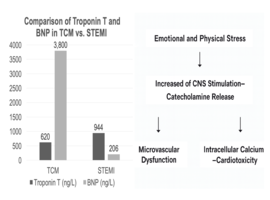
Takotsubo Cardiomyopathy: A Clinical Case of Stress-Induced Cardiomyopathy Without Precipitating Factors
Abstract

Background: Takotsubo cardiomyopathy is a transient left ventricular dysfunction typically triggered by emotional or physical stress. It is characterized by regional wall motion abnormalities that extend beyond a single coronary artery distribution and often resolves within weeks.
Case Summary: A 45-year-old woman with hypertension and anxiety presented with acute retrosternal chest pain radiating to the left arm. She denied recent psychological or physical stressors. Serial troponins were elevated, and echocardiography showed apical hypokinesia. Coronary angiography revealed no obstructive coronary disease, confirming stress-induced cardiomyopathy. She was managed conservatively and discharged in stable condition.
Discussion: Although classically seen in postmenopausal women under stress, Takotsubo cardiomyopathy can occur without identifiable triggers. This case highlights the importance of recognizing atypical presentations to avoid unnecessary interventions and guide appropriate care.

Keywords: Takotsubo cardiomyopathy; Acute coronary syndrome; Cardiac biomarkers; Electrocardiographic abnormalities; Brain natriuretic peptide