
Clinical Images and Case Reports Journal | PubMed
  • contact@literaturepublishers.org
  • Whitley Bay, NE26 2HU, England, UK
  • Submit Manuscript
Article Details

Clinical Image

Volume 4, Issue 5 (May Issue)

Tibial Intravascular Large B-Cell Lymphoma

Ting-Wei Kao1, Yu-Feng Lin2, Chia-Lin Tseng2,3,4 and Nin-Chieh Hsu2,5*

1Department of Internal Medicine, National Taiwan University Hospital, Taipei 100, Taiwan

2Division of Hospital Medicine, Department of Internal Medicine, National Taiwan University Hospital, Taipei 100, Taiwan

3Department of Family Medicine, National Taiwan University Hospital, Taipei 100, Taiwan

4Institute of Health Policy and Management, College of Public Health, National Taiwan University, Taipei 100, Taiwan

5Department of Hospital Medicine, Taipei City Hospital Zhongxing Branch, Taipei 103, Taiwan

*Corresponding author: Nin-Chieh Hsu, National Taiwan University Hospital, Address: No.1, Changde Street, Zhongzheng District, Taipei 100, Taiwan. E-mail: chesthsu@gmail.com

Received: May 09, 2022; Accepted: May 17, 2022; Published: June 02, 2022

Citation: Wei Kao T, Feng Lin Y, Lin Tseng C, Chieh Hsu N, et al. Tibial Intravascular Large B-Cell Lymphoma. Clin Image Case Rep J. 2022; 4(5): 235.
Tibial Intravascular Large B-Cell Lymphoma
Abstract

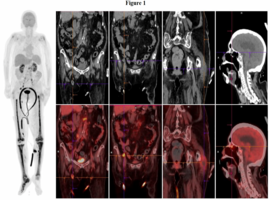
A 72-year-old female presented with disturbed consciousness. She sustained persistent fever for recent three months albeit under extensive antibiotics. Cultures of blood, sputum, and body fluids were negative. Bone marrow biopsy was also unrevealing. Eventual whole-body positron emission tomography demonstrated diffusely increased tracer activity at bilateral long bones of lower extremities. Additionally, mild tracer activity was illustrated at sacral subcutaneous infiltrations, bilateral deltoid muscles, bilateral gluteus muscles, femoral trochanter, and left nasal cavity (Figure 1). Magnetic resonance imaging also exhibited corresponding local enhancement and right external iliac lymphadenopathy (Figure 2). A left tibia bone biopsy further demonstrated the infiltration of atypical lymphoid cells, which possessed large pleomorphic vesicular nuclei, well-circumscribed nodules, and in addition to strongly positive CD20 staining (Figure 3). Intravascular large B cell lymphoma (IVLBCL) was therein rendered. Palliation was opted as her terminal care, and the patient expired one month later.

We herein reported the first case of tibial IVLBCL with enigmatic presentation as bilateral leg pain aggravating to eventual coma. Unfavorable outcome was inevitable in this individual considering late diagnosis and limited treatment. Challenges in prompt recognition and its fulminant course bring out dismal prognosis. Patients with prolonged fever and unusual inflammatory scan outcome necessitated the inclusion of IVLBCL among differential diagnosis. Biopsy at any involved site, random skin, or cell-free genetic sampling should be considered based on respective accessibilities and clinical contexts [1].

The regimen for IVLBCL was relied on the experiences from treating diffuse large-B cell lymphoma not otherwise specified, whilst augmenting chemotherapy with fair blood brain barrier penetrating bioavailability remained controversial [2]. As the accumulation of understanding upon the pathogenesis and disease characteristics, advancements in the diagnostic and therapeutic modalities will improve the holistic care for such population.