
Clinical Images and Case Reports Journal | PubMed
  • contact@literaturepublishers.org
  • Whitley Bay, NE26 2HU, England, UK
  • Submit Manuscript
Article Details

Clinical Image

Volume 7, Issue 5

Total Duodenopancreatectomy for Intraductal Papillary Mucinous Tumor

Badr Tarif*, Ibn Sbih Oualid, Aymane Jbilou, Younes Aggouri and Said Ait laalim

Department of General Surgery, Mohammed VI University Hospital, Faculty of Medicine and Pharmacy, Abdelmalek Essaadi University, Tanger, Morocco

*Corresponding author: Badr Tarif, Department of General Surgery, University Hospital Center of Tangier, Abdelmalek Essaâdi University of Tangier, Morocco.
E-mail: tarif.badr@gmail.com

Received: July 19, 2025; Accepted: August 02, 2025; Published: August 15, 2025

Citation: Tarif B, Oualid IS, Jbilou A, et al. Total Duodenopancreatectomy for Intraductal Papillary Mucinous Tumor (IPMT). Clin Image Case Rep J. 2025; 7(5): 567.
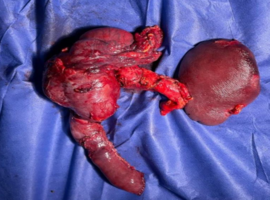
Total Duodenopancreatectomy for Intraductal Papillary Mucinous Tumor
Abstract

Intraductal papillary mucinous tumors (IPMTs) of the pancreas are characterized by a proliferation of the pancreatic ductal epithelium with papillary architecture composed of mucin-producing cells. They may arise from the branch ducts, the main pancreatic duct, or both (in which case they are classified as mixed-type IPMTs).
We present the case of a 47-year-old patient with a history of poorly controlled type 1 diabetes managed with insulin, and hypothyroidism treated with Levothyrox®.
The patient was admitted for clinical evaluation and management of an intraductal papillary mucinous neoplasm (IPMN) involving both the head and tail of the pancreas, diagnosed following a cholestatic jaundice that had been evolving for 1 month. Magnetic Resonance Cholangiopancreatography (MRCP): Appearance suggestive of mixed-type IPMN without evidence of degeneration, Dilation of the main pancreatic duct measuring 10 mm. And of the main biliary duct.
Endoscopic ultrasound (EUS): Multiple unilocular cystic lesions, the largest measuring 50 mm in greatest dimension, located in the pancreatic head extending towards the tail. The lesion communicates with the main pancreatic duct (Wirsung’s duct), which is moderately dilated, with dilation of the secondary ducts.
The preoperative workup was unremarkable and the multidisciplinary team (MDT) decision was to proceed with surgery. The patient underwent a total duodenopancreatectomy. The postoperative course was uneventful and the patient was discharged on postoperative day 5 with regular follow-up and endocrine monitoring.