
Clinical Images and Case Reports Journal | PubMed
  • contact@literaturepublishers.org
  • Whitley Bay, NE26 2HU, England, UK
  • Submit Manuscript
Article Details

Case Report

Volume 8, Issue 2

Beyond Opportunistic Infections: Unmasking CD8+ Encephalitis in Virologically Suppressed HIV Patient

Yasmeen Aboussaf1* and Yaroslav Buryk2

1Fourth-year Medical Student, American University of the Caribbean School of Medicine, Brookfield, IL, USA
2Assistant Professor of Clinical Medicine, University of Miami. Department of Pulmonary, Critical Care, and Sleep Medicine, USA

*Corresponding author: Yasmeen Aboussaf, Fourth-year Medical Student, American University of the Caribbean School of Medicine, IL, USA.
E-mail: YasmeenAboussaf@students.aucmed.edu

Received: April 06, 2026; Accepted: April 24, 2026; Published: May 05, 2026

Citation: Aboussaf Y, Buryk Y. Beyond Opportunistic Infections: Unmasking CD8+ Encephalitis in Virologically Suppressed HIV Patient. Clin Image Case Rep J. 2026; 8(2): 589.
Beyond Opportunistic Infections: Unmasking CD8+ Encephalitis in Virologically Suppressed HIV Patient
Abstract

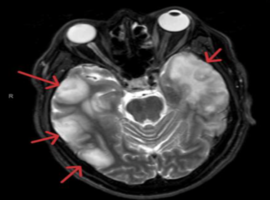
CD8+ encephalitis is a rare inflammatory process of the central nervous system (CNS) commonly seen in virologically suppressed diseases, like HIV. This condition is characterized by the infiltration of CD8+ cytotoxic T-lymphocytes into brain parenchyma and often mimics opportunistic infections and CNS malignancies, leading to diagnostic delays. We report a 56-year-old male with well-controlled HIV and undetectable viral load, who developed new-onset generalized tonic-clonic seizures, followed by aphasia and focal motor activity. Neuroimaging revealed multifocal hyperintensities without acute infarction or mass effect. Cerebrospinal fluid studies, including infectious and autoimmune panels, were negative. Based on complete absence of infectious, neoplastic, or structural etiologies, as well as the patient’s rapid clinical improvement with corticosteroid therapy, a diagnosis of CD8+ encephalitis was made. Brain biopsy was considered to confirm the diagnosis but was ultimately deferred due to thrombocytopenia and clinical improvement. This case highlights the importance of incorporating CD8+ encephalitis in HIV patients presenting with acute or subacute neurological symptoms. While relatively rare, this presentation may occur in HIV patients with undetectable viral load. Elimination of infectious and neoplastic causes, characteristic radiological appearances, and favorable response to corticosteroids can help support the diagnosis of CD8+ encephalitis when histopathological confirmation is lacking.

Keywords: CD8 Encephalitis; HIV-associated encephalitis; PML-IRIS; CNS lymphoma; Opportunistic infections; CNS inflammation